BAÑOS ÁRABES
- DESCRIPTION
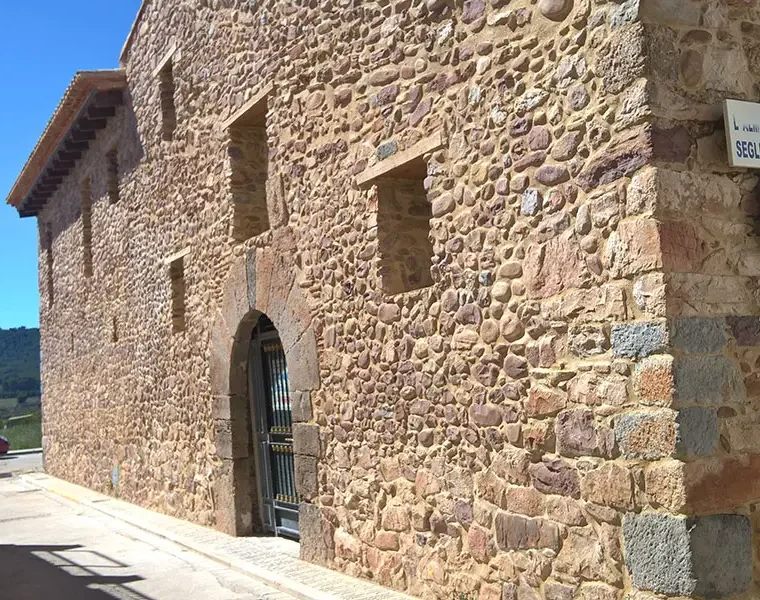
The Arab Baths of the Valencian town of Torres Torres, in the region of Camp de Morvedre, are possibly the best preserved in the entire Valencian Community. These public baths from the post-Islamic period are located near the current square of the town's Church, next to the cistern from which they were supplied. The precise chronology of the construction of these baths, which follow the classic typology of the Islamic Hammam, is not yet explicitly defined and we find various hypotheses about when these baths were built.
Thus, the architect and researcher of the heritage of Torres Torres and its region, Juan Corbalán de Celis, points out in his article “The current square of the Church of Torres Torres”, included in his work “Torres Torres. Floresta de pequeñas historias”, that the origin of the baths could even be before the time of the reconquest, since after this the place loses importance and there is no point in building baths of such magnitude. On the other hand, other investigations carried out after several archaeological works carried out on this monument in 2003 point to a later construction, during the 14th century, a date that appears in the General Inventory of Valencian Cultural Heritage. In addition, the first documentary reference that we have of this monument corresponds to 1555. In any case, these facilities reproduce the basic layout of Hammam. They were declared a National Monument in 1938 and are one of the three best preserved Arab baths in the Valencian Community. Corbalán de Celis, whom we follow in this article, highlights the uniqueness of finding baths of these characteristics in an urban settlement whose origin is markedly military. Torres Torres is located on the so-called Via del Palancia, a traditional communication route between the current territories of Aragon and Valencia. For this reason, it became a place of passage and rest for travelers, which would give reason for having simple baths, but of relative importance, given its low population. The architecture reinforces this approach, as the access door to the baths is located on the north façade of the complex, in front of which the royal road probably passed, following the Roman road. The Baths of Torres Torres ceased this function of public toilets in the centuries after their Christianisation. However, the inhabitants of the municipality may have reused them as a water tank, linked to the nearby cistern, a decision that may have allowed the monument to survive to this day in a very good state of conservation.
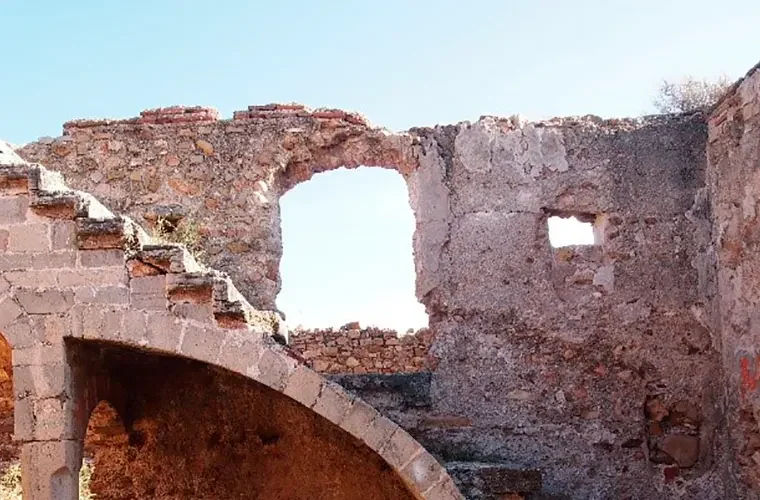
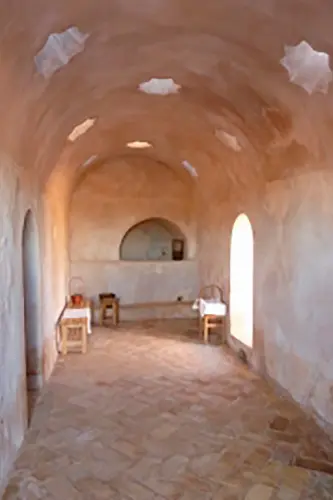
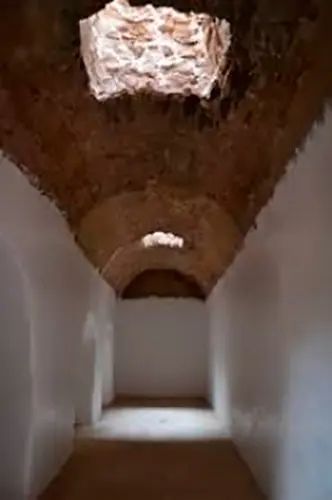
The complex of the Arab Baths consists of three rectangular rooms covered with vaults and arranged in parallel, with two other small adjoining rooms, used as a boiler to heat the water and as a latrine. These three main spaces cover those at the ends with a barrel vault and the central one with a lowered vault. In the domes of the baths there is a series of star-shaped skylights that provide light to the room. These rooms correspond to the characteristic bath rooms of hammams. The central room corresponds to the warm bath (bayt al-wastani). The space of this nave is visually divided by two semicircular arches made of brick. Attached to this is the hot room (bayt al-sajun), which repeats the layout of the warm room. Next to this space is the room dedicated to the boiler, which was provided with a wood-burning oven that would heat the water needed for the baths. On the side facing west is the cold room (bayt al-barid). This nave lacks the spatial division by transverse arches that the two previous ones have. Attached to it are what would be the latrines of the Arab Baths of Torres Torres. The passage between the different rooms and bathing spaces was perpendicular to the naves. The complex has an almost rectangular floor plan. The walls are made of masonry, following the Arab construction tradition. The pavement of this monument, a Site of Cultural Interest (BIC), is made of baked bricks arranged in a herringbone shape.
- LOCATION
- CHARACTERISTICS
Location
Torres Torres
Altitude
168 m.
Year
s.XIV
Category
Cultural heritage
PLACES OF INTEREST
- CHARACTERISTICS
Location
Torres Torres
Altitude
168 m.
Year
s.XIV
Category
Cultural heritage